The Land Rover Defender (introduced as the Land Rover One Ten, joined in 1984 by the Land Rover Ninety, plus the extra-length Land Rover One Two Seven in 1985) is a series of British off-road cars and pickup trucks. They have four-wheel drive, and were developed in the 1980s from the Land Rover series which was launched at the Amsterdam Motor Show in April 1948. Following the 1989 introduction of the Land Rover Discovery, the term 'Land Rover' became the name of a broader marque, no longer the name of a specific model; thus in 1990 Land Rover renamed them as Defender 90 and Defender 110 and Defender 130 respectively.
The vehicle, a British equivalent of the Second World War derived (Willys) Jeep, gained a worldwide reputation for ruggedness and versatility. With a steel ladder chassis and an aluminium alloy bodywork, the Land Rover originally used detuned versions of Rover engines.
Though the Defender was not a new generation design, it incorporated significant changes compared to the Land Rover series, such as adopting coil springs front and rear. Coil springs offered both better ride quality and improved axle articulation. The addition of a centre differential to the transfer case gave the Defender permanent four-wheel-drive capability. Both changes were derived from the original Range Rover, and the interiors were also modernised. Whilst the engines were carried over from the Series III, a new series of modern and more powerful engines was progressively introduced.
Even when ignoring the series Land Rovers and perhaps ongoing licence products, the 90/110 and Defender models' 33-year production run were ranked as the sixteenth longest single-generation car in history in 2020.
In 2020, Jaguar Land Rover introduced an all new generation of Land Rover Defender Land Rover Defender (L663) switching from body on chassis to integrated bodywork and from live, rigid axles to all around independent suspension.
Tuesday, April 15, 2025
Mini GT 1:64: Land Rover Defender 110
Mini GT 1:64: 1971 Range Rover
The Range Rover is a 4x4, mid-size off-road vehicle series produced from 1970 to 1996 - initially by the Rover (later Land Rover) division of British Leyland, and latterly by the Rover Group.
The first generation of vehicles produced under the Range Rover name, it was built as a two-door model for its first 11 years, until a four-door also became available in 1981. The Range Rover then successfully moved upmarket during the 1980s, and remarkably debuted in the U.S. as a 17-year old model at the 1987 Los Angeles Auto Show.
Mini GT 1:64: Porsche 911 Carrera RS 2.7
The 911 traces its roots to sketches drawn by Ferdinand "Butzi" Porsche in 1959. The 911 was developed as a more powerful, larger, and more comfortable replacement for the 356, the company's first model, and was presented at the 1963 Frankfurt Motor Show. (German: Internationale Automobil-Ausstellung). The car was developed with the proof-of-concept twin-fan Type 745 flat-six engine, but the car presented at the auto show had a non-operational mockup of a single-fan engine, receiving a working Typ 901 engine in February 1964.
Mini GT 1:64: Lancia Stratos HF Stradale
The Lancia Stratos HF (Tipo 829), known as Lancia Stratos, is a rear mid-engined sports car designed for rallying, made by Italian car manufacturer Lancia. It was highly successful in competition, winning the World Rally Championship in 1974, 1975 and 1976; as well as winning the 1974 Targa Florio, winning the Tour de France Automobile five times and the Giro d'Italia automobilistico three times.
Mini GT 1:64: Lancia Delta HF Integrale Evoluzione Martini Racing
The Lancia Delta HF is a Group A rally car built for the Martini Lancia by Lancia to compete in the World Rally Championship. It is based upon the Lancia Delta road car and replaced the Lancia Delta S4. The car was introduced for the 1987 World Rally Championship season and dominated the World Rally Championship, scoring 46 WRC victories overall and winning the constructors' championship a record six times in a row from 1987 to 1992, in addition to drivers' championship titles for Juha Kankkunen (1987 and 1991) and Miki Biasion (1988 and 1989), making Lancia the most successful marque in the history of the WRC and the Delta the most successful car.👀
Hot Wheels 1:64: Ford RS200
The Ford RS200 is a mid-engined, all-wheel-drive sports car that was produced by Ford Motorsport in Boreham, UK, from 1984 to 1986. The road-going RS200 was the basis for Ford's Group B rally car and was designed to comply with FIA homologation regulations, which required 200 parts kits to be produced and at least one road-legal car to be assembled. It was first displayed to the public at the Belfast Motor Show.
Hot Wheels 1:64: 1993 Ford Escort RS Cosworth
The Ford Escort RS Cosworth is a homologation special of the fifth generation European Ford Escort. It was designed to qualify as a Group A car for the World Rally Championship in which it competed between 1993 and 1998. It was available as a road car from 1992 until 1996. The powertrain was only fitted to this version of the Escort, a longitudinally mounted Cosworth YBT, a highly tunable turbocharged 2.0 L (1,993 cc) with a bore x stroke of 90.8 mm × 77 mm (3.57 in × 3.03 in) Inline-four engine which had an output of 227 PS (167 kW; 224 bhp) in standard trim. Tuning companies have achieved power outputs in excess of 1,000 bhp (746 kW; 1,014 PS).
Hot Wheels 1:64: 1986 MG Metro 6R4
Created for the short-lived Group B rally category, the 4WD mid engined MG Metro 6R4 of 1984 (standing for 6-cylinder, Rally, 4-wheel-drive) was a world away from the best selling city car to which it only bears a superficial cosmetic resemblance. The competition car effectively only shared the name of the production Metro as it featured a mid-mounted engine with four-wheel drive transmission enclosed within a semi-monocoque seam-welded tubular chassis. The development of this vehicle had been entrusted to Williams Grand Prix Engineering.
Hot Wheels 1:64: Lancia Delta HF Integrale
The Lancia Delta HF is a Group A rally car built for the Martini Lancia by Lancia to compete in the World Rally Championship. It is based upon the Lancia Delta road car and replaced the Lancia Delta S4. The car was introduced for the 1987 World Rally Championship season and dominated the World Rally Championship, scoring 46 WRC victories overall and winning the constructors' championship a record six times in a row from 1987 to 1992, in addition to drivers' championship titles for Juha Kankkunen (1987 and 1991) and Miki Biasion (1988 and 1989), making Lancia the most successful marque in the history of the WRC and the Delta the most successful car.👀
Mini GT (left) & Hot Wheels (right) 1:64: Lancia Delta HF Integrale Evoluzione
The Lancia Delta HF is a Group A rally car built for the Martini Lancia by Lancia to compete in the World Rally Championship.👀
Here is a visual comparison of the Mini GT (left) and the Hot Wheels (right) version of the same car...
Wednesday, April 2, 2025
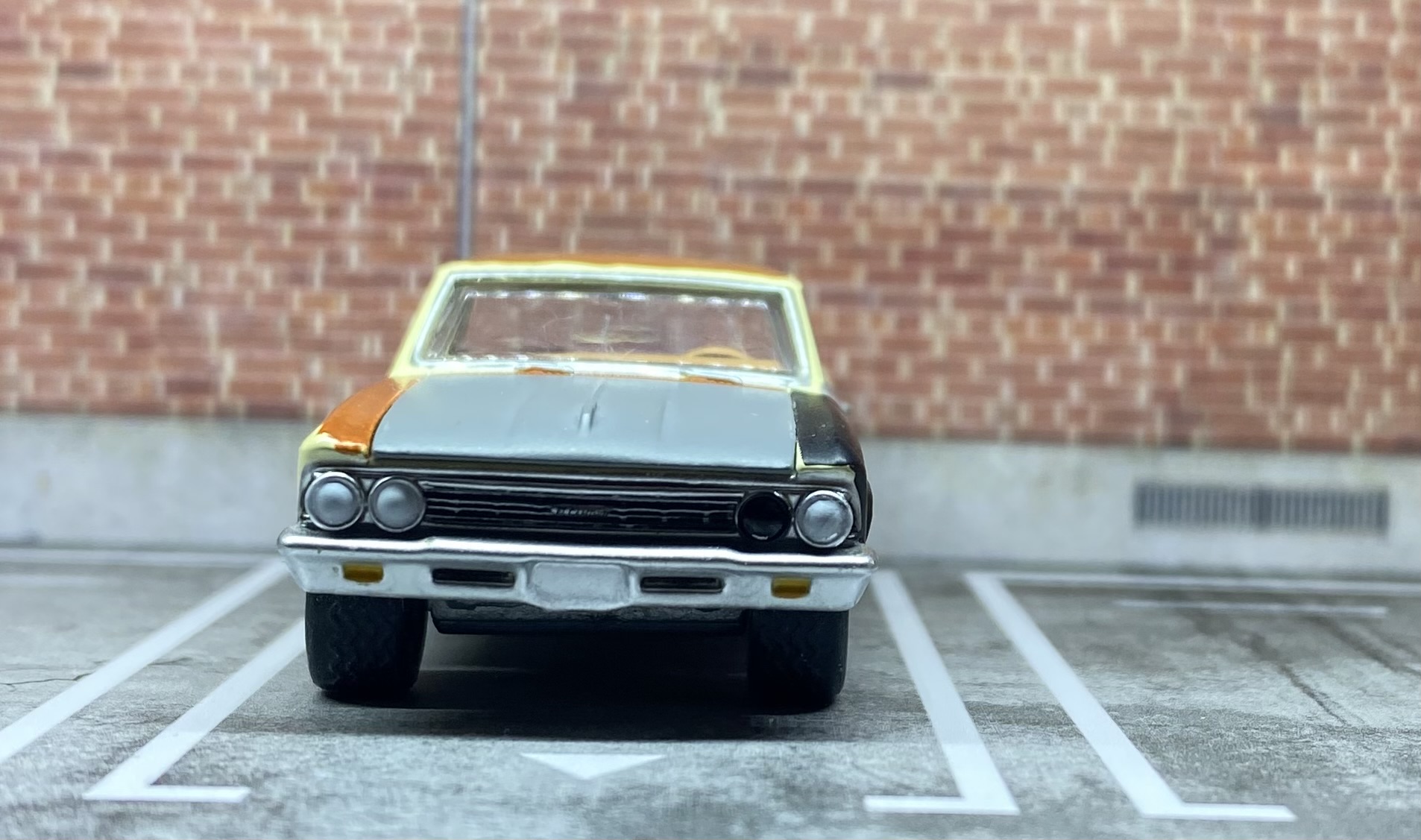
Johnny Lightning 1:64: 1966 Chevrolet El Camino
The Chevrolet El Camino is a coupé utility vehicle that was produced by Chevrolet between 1959–1960 and 1964–1987. Unlike a standard pickup truck, the El Camino was adapted from the standard two-door Chevrolet station wagon platform and integrated the cab and cargo bed into the body.
Introduced in the 1959 model year in response to the success of the Ford Ranchero coupé utility, its first run, based on the Biscayne's B-body, lasted only two years. Production resumed for the 1964–1977 model years based on the Chevelle platform, and continued for the 1978–1987 model years based on the GM G-body platform.
Although based on corresponding General Motors car lines, the vehicle is classified in the United States as a pickup. GMC's badge engineered El Camino variant, the Sprint, was introduced for the 1971 model year. Renamed Caballero in 1978, it was also produced through the 1987 model year.
M2 Machines 1:64: 1969 Plymouth Road Runner
The Plymouth Road Runner is a muscle car introduced by Chrysler in the United States for the 1968 model year and marketed under its Plymouth brand. Initially based on the Belvedere, the brand's basic mid-size model, the Road Runner combined a powerful engine with a spartan trim level and a price that undercut increasingly upscale and expensive muscle cars such as the Pontiac GTO and Plymouth's own GTX. It was initially a sales success.
The Road Runner was built in three generations on the mid-size B platform. Like most muscle cars, its performance and sales declined in the 1970s due to an increasing focus on fuel economy and the adoption of more stringent U.S. emission standards. The nameplate became to a trim package for the compact Plymouth Volaré for model year 1976, no longer offering any special performance capability-and was discontinued in 1980.