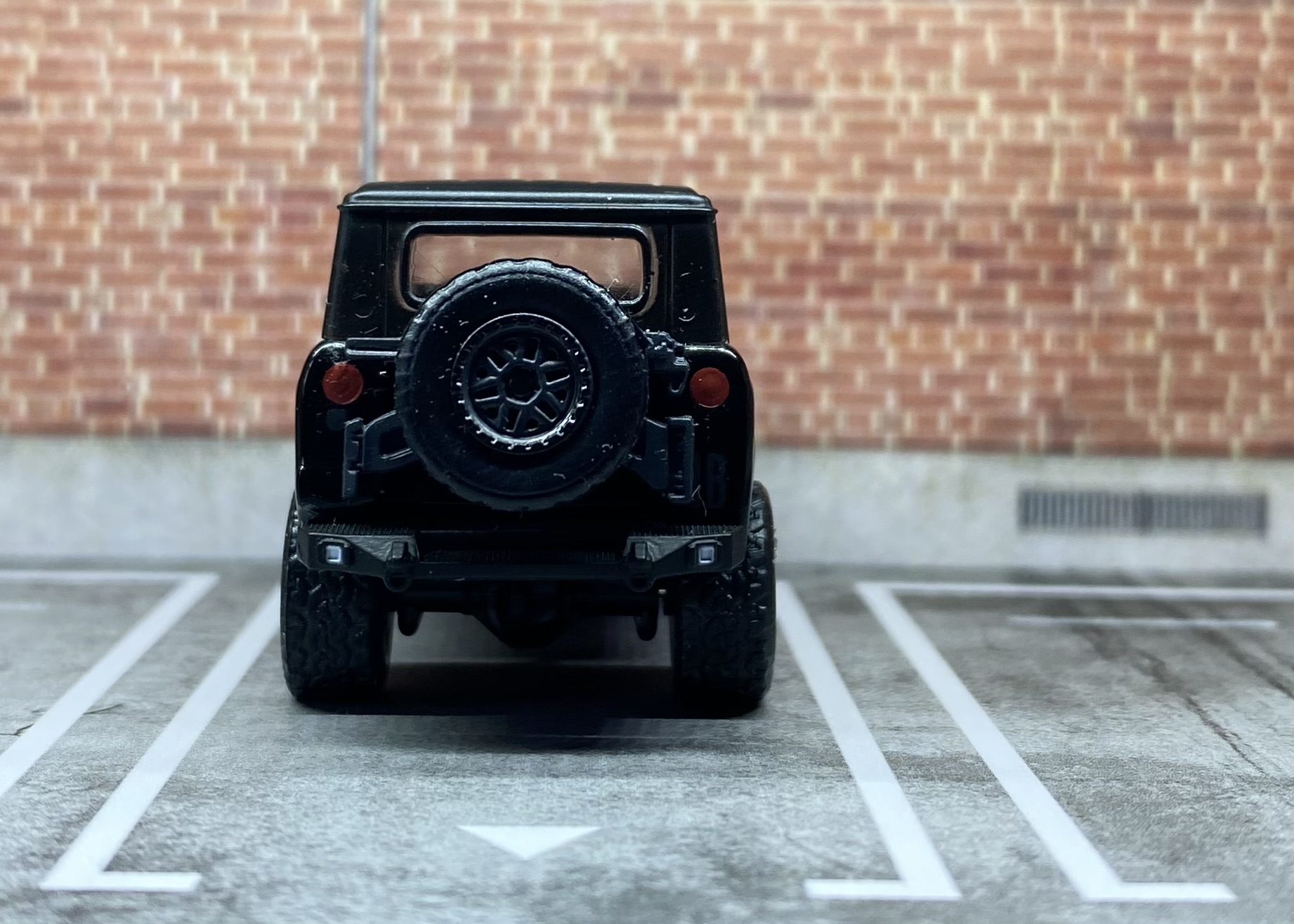
Welcome to my blog. It was initially created in 2012 to post music I recorded. I posted a few quick experiments in 2013 and never posted music again, though I did record more. Since I already owned lots of boats and outboard motors, I decided to post about boats, ATVs and snowmobiles. I posted a few snowmobile photos and then nothing until 2025. Since I planned to sell my cottage and move south, I started selling all my boats and motors and switched to Radio Control vehicles in early 2024. In February 2025 I started collecting 1:64 scale diecast vehicles and decided to catalogue them on this blog...may you find freedom in my toys!

Wednesday, April 23, 2025

Greenlight 1:64: 1969 Ford Mustang Boss 302

The Mustang Boss 302 is a high-performance 302 cu in (4.9 L) H.O. V8-powered variant of the Ford Mustang originally produced by Ford in 1969 and 1970. Developed to meet homologation requirements to compete in Trans Am racing, it was Ford's response to the success of the Chevrolet Camaro Z/28 in the 5 L (305.1 cu in) and under SCCA series since 1967. While substantial modifications were required to the stock Boss 302 to be competitive on the track, many thousands were sold to the public in a street-legal form that included a refined high-performance motor and upgrades to the suspension and brakes over base Mustangs.

Ford revived the Boss 302 name for another two year production run in 2012 and 2013.


Greenlight 1:64: 1961 Chevrolet Corvette Convertible

The Chevrolet Corvette is a line of American two-door, two-seater sports cars manufactured and marketed by General Motors under the Chevrolet marque since 1953. Throughout eight generations, indicated sequentially as C1 to C8, the Corvette is noted for its performance, distinctive styling, lightweight fiberglass or composite bodywork, and competitive pricing. The Corvette has had domestic mass-produced two-seater competitors fielded by American Motors, Ford, and Chrysler; it is the only one continuously produced by a United States auto manufacturer. It serves as Chevrolet's halo car.

In 1953, GM executives accepted a suggestion by Myron Scott, then the assistant director of the Public Relations department, to name the company's new sports car after the corvette, a small, maneuverable warship. Initially, a relatively modest, lightweight 6‑cylinder convertible, subsequent introductions of V8 engines, competitive chassis innovations, and rear mid-engined layout have gradually moved the Corvette upmarket into the supercar class. In 1963, the second generation was introduced in coupe and convertible styles. The first three Corvette generations (1953–1983) employed body-on-frame construction, and since the C4 generation, introduced in 1983 as an early 1984 model, Corvettes have used GM's unibody Y‑body platform. All Corvettes used front mid-engine configuration for seven generations, through 2019, and transitioned to a rear mid-engined layout with the C8 generation.

Initially manufactured in Flint, Michigan, and St. Louis, Missouri, the Corvette has been produced in Bowling Green, Kentucky, since 1981, which is also the location of the National Corvette Museum. The Corvette has become widely known as "America's Sports Car." Automotive News wrote that after being featured in the early 1960s television show Route 66, "the Corvette became synonymous with freedom and adventure," ultimately becoming both "the most successful concept car in history and the most popular sports car in history."


Johnny Lightning 1:64: 1976 Lotus Esprit S1

The Lotus Esprit is a sports car built by Lotus Cars from 1976 to 2004 at their Hethel, England factory. It has a rear mid-engine, rear-wheel-drive layout. Together with the Lotus Elise / Exige, it is one of Lotus' most long-lived models.

The Esprit was among the first of the (near) straight-lined, hard-edge creased, and sometimes wedge-shaped, polygonal "folded paper" designs of the prolific, and highly successful Italian industrial and automotive designer Giorgetto Giugiaro. The Esprit's backbone chassis was later adapted to carry the body of the DeLorean car, another low-bodied, Giugiaro-drawn, sharp-creased, wedge-shaped sportscar design. In 1978, the first updates led to the series 2 and 2.2 L (134 cu in) engined Esprit S2.2, made until the 1982–1988 Series 3 and Turbo Esprit models, that used a 1980 Giugiaro designed aerodynamic and aesthetic restyling package.

The Lotus Esprit however, lived on through the 1990s, and into the 2000s. It received its first significant restyling by designer Peter Stevens, who also did styling on the McLaren F1. Stevens gave the Esprit overall softer lines and shapes, but the car did not get a new series number – it is instead often just called the 'Stevens Esprit', or by its project number, the X180, made from 1988 to 1994.

In 1994, an official Series 4 Esprit, drawn by designer Julian Thomson, had a further rounded shape, especially the bumper sections and lower body of the car. Styling-wise, this became the most long-lived Esprit (1994-2004), only receiving its last changes, by Russell Carr in 2002.

Over the years, the performance of the Esprit's 4-cylinder engine was increased from around 150 PS (148 hp; 110 kW) and just under 200 N⋅m (148 lb⋅ft) of torque, to double those power figures, mainly through greater inlet and exhaust flow, and strong turbo-charging. And from 1996, a new 3.5 L (214 cu in) V8 twin-turbo engine was added, offering 355 PS (350 hp; 261 kW). Contrary to a long list of low-volume British (sports) cars, with the 3.5 l Rover V8 engine, the Esprit received a Lotus in-house designed V8. Top speed rose from some 214 km/h (133 mph) in 1976, to over 280 km/h (174 mph) for the V8, twenty years later.

After a 28-year production run, the Esprit was one of the last cars made with pop-up headlights, together with the 5th generation Chevrolet Corvette.


Johhny Lightning 1:64: 1954 Chevrolet Corvair Concept Car

The Chevrolet Corvair is a rear-engined, air-cooled compact car manufactured and marketed by Chevrolet over two generations between 1960 and 1969. A response to the Volkswagen Beetle, it was offered in 4-door sedan, 2-door coupe, convertible and 4-door station wagon in its first generation (1960-1964), and as a 2-door coupe, convertible or 4-door hardtop in its second (1965-1969). It was also offered as a subseries known as the Corvair 95 (1961-1965), which consisted of a passenger van, commercial van, and pickup truck variant. Total production was approximately 1.8 million vehicles from 1960 until 1969.

The name "Corvair" was first applied in 1954 to a Corvette-based concept with a hardtop fastback-styled roof, part of the Motorama traveling exhibition. When applied to the production models, the "air" part referenced the engine's cooling system.


Greenlight 1:64: 2022 Ford GT 64 Prototype Heritage Edition

The Ford GT is a mid-engine two-seater sports car manufactured and marketed by American automobile manufacturer Ford for the 2005 model year in conjunction with the company's 2003 centenary. The second generation Ford GT became available for the 2017 model year.

The GT recalls Ford's historically significant GT40, a consecutive four-time winner of the 24 Hours of Le Mans (1966-1969), including a 1-2-3 finish in 1966.


Johnny Lightning 1:64: 1965 Chevrolet C10 Stepside with Bass Boat

The Chevrolet C/K is a series of trucks that was manufactured by General Motors from the 1960 to 2002 model years. Marketed by both the Chevrolet and GMC divisions, the C/K series encompassed a wide range of vehicles. While most commonly associated with pickup trucks, the model line also included chassis-cab trucks and medium-duty trucks and served as the basis for GM full-size SUVs. Through its entire production, the model line competed directly against the Ford F-Series and the Dodge D series (later the Dodge Ram pickup).

Used for both the model branding and the internal model code, "C" denoted two-wheel drive, while "K" denoted four-wheel drive. Four generations of the C/K series were produced, including the GM monikered second-generation "Action Line" and third-generation "Rounded Line" vehicles (colloquially aka Square-Body trucks). For the fourth-generation (colloquially also known as OBS trucks), Chevrolet kept using the C/K designation while GMC revised its branding, changing to a singular GMC Sierra nameplate (C/K remained as an internal model code).

For South America, the model line was manufactured by General Motors de Argentina from 1960 to 1978, Sevel Argentina from 1986 to 1991, and General Motors Brazil, who produced versions of the model line for Brazil, Argentina, and Chile from 1964 to 2001.

As GM entered the 1990s, the company revised its truck ranges, replacing the medium-duty C/K trucks with the Chevrolet Kodiak/GMC TopKick for 1990. For 1999, GM replaced the fourth-generation C/K pickup trucks with an all-new model line; in line with GMC, Chevrolet dropped the C/K nameplate (in favor of a singular Chevrolet Silverado nameplate). Initially marketed with its successor, the final C/K pickup trucks were produced for the 2000 model year. From 2001 to 2002, the final vehicles of the C/K model line were medium-duty chassis cab trucks.


Greenlight 1:64: 1976 Jeep CJ-5 Renegade

The Jeep CJ models are a series and a range of small, open-bodied off-road vehicles and compact pickup trucks, built and sold by several successive incarnations of the Jeep automobile marque from 1945 through 1986. The 1945 Willys "Universal Jeep" was the world's first mass-produced civilian four-wheel drive car.

In 1944, Willys-Overland, the primary manufacturer of the World War II military Jeep, built the first prototypes for a commercial version – the CJ, short for "civilian Jeep". The design was a direct evolution from the war jeep, but the most obvious change was adding a tailgate, and relocating the spare wheel to the side. Also, besides adding basic civilian amenities and options and legally-compliant lighting, the CJ required a sturdier drivetrain than the war jeep, because the targeted rural buyers would work the vehicles hard and expect years of durability, instead of mere weeks as during WWII.

From then on, all CJ Jeeps consistently had a separate body and frame, rigid live axles with leaf springs both front and rear, a tapering nose design with flared fenders, and a fold-flat windshield, and could be driven without doors. Also, with few exceptions, they had part-time four-wheel drive systems, with the choice of high and low gearing, and open bodies with removable hard or soft tops. A few stand-out changes during 42 model years were the introductions of round-fendered vs. flat-fendered bodies (1955 CJ-5), straight-6 and V8-engines, automatic gearboxes, and different 4-wheel drive systems. The 1976 CJ-7 stretched the wheelbase by 10 inches (25 cm), and made doors and a removable hardtop common items.

After remaining in production through a range of model numbers, and several corporate parents, the Jeep CJ line was officially ended after 1986. More than 1.5 million CJ Jeeps were built, having continued the same basic body style for 45 years since the Jeep first appeared. Widely regarded as "America's workhorse", the CJs have been described as "probably the most successful utility vehicle ever made." American Motors VP Joseph E. Cappy said the end of "CJ production will signal an end of a very important era in Jeep history." In 1987, the Jeep CJ-7 was replaced by the first-generation Jeep Wrangler. Looking very similar and riding on the same wheelbase as the CJ-7, it carried over some important components, including its use of leaf springs.

The similar model the DJ "Dispatcher" was introduced in 1956 as a two-wheel drive version with open, fabric, or a closed steel body in both left- and right-hand drives for hotel, resort, police, and later United States Postal Service markets.


Greenlight 1:64: 1974 Volkswagen Type 181 (the Thing)

The Volkswagen Type 181 is a two-wheel drive, four-door convertible, manufactured and marketed by Volkswagen from 1968 until 1983. Originally developed for the West German Army, the Type 181 also entered the civilian market as the Kurierwagen (“courier car”) in West Germany, the Trekker (RHD Type 182) in the United Kingdom, the Thing in the United States and Canada (1973-74), the Safari in Mexico and South America, and Pescaccia in Italy.

Civilian sales ended after model year 1980.

Manufactured in Wolfsburg, West Germany (1968-1974), Hannover, West Germany (1974-1975), Emden, West Germany (1975-1978), Puebla, Mexico (1970-1980), and Jakarta, Indonesia (1972-1980), the Type 181 shared its mechanicals with Volkswagen's Type 1 (Beetle) and the pre-1968 Volkswagen Microbus, its floor pan with the Type 1 Karmann Ghia, and its concept with the company's Kübelwagen, which had been used by the German military during World War II.

The overall configuration loosely recalls the chic, open beach cars of the 1960s, including the BMC Mini Moke, Fiat Ghia Jolly, Renault Rodeo, Citroën Méhari and Meyers Manx. All four doors were removable and interchangeable, the windshield folded flat, and the convertible roof could be removed for al fresco driving. The spartan interior featured vinyl covered bucket seats, painted sheet metal, drain holes and perforated rubber mats. A fiberglass hardtop and trunk-mounted auxiliary heater were optional.


Greenlight 1:64: 1970 AMC Jeepster Commando

The Jeepster Commando is a compact-sized recreational vehicle produced by Kaiser Jeep from 1966 until 1971 and American Motors Corporation (AMC) from 1971 through 1973. It followed the concept of the original 1948 through 1951 Willys-Overland Jeepster. The new Jeepster Commando was available in several body styles, including pickup truck, convertible, roadster, and two-door wagon.

Following the acquisition of Jeep by American Motors Corporation (AMC) in 1970, the vehicle underwent a redesign for the 1972 model year, featuring new front-end styling, longer wheelbase, and AMC engines, and was renamed the Jeep Commando.

The model was discontinued after the 1973 model year and replaced by the full-size Jeep Cherokee.


Greenlight (Black Bandit) 1:64: 1969 International Harvester Scout

The International Scout is an off-road vehicle produced by International Harvester from 1960 to 1980. A precursor of more sophisticated SUVs to come, it was created as a competitor to the Jeep, and it initially featured a fold-down windshield. The Scout and second-generation Scout II were produced in Fort Wayne, Indiana as two-door trucks with removable hard tops, with options of a full-length roof, half-cab pickup, and/or soft top.


Tarmac Works 1:64: Saab 900 Turbo

The Saab 900 is a mid-sized automobile produced by Swedish manufacturer Saab from 1978 until 1998 in two generations: the first from 1978 to 1994, and the second from 1994 to 1998.

The first-generation car was based on the Saab 99 chassis, though with a longer front end to meet U.S. frontal crash regulations and to make room for the turbo-charged engines, air conditioning and other equipment that was not available in the early days of the 99 model. The 900 was produced in 2- and 4-door sedan, and 3- and 5-door hatchback configurations and, from 1986, as a cabriolet (convertible) model. There were single- and twin-Zenith carburettor; fuel injected, and turbocharged engines, including Full Pressure Turbo (FPT) and, in European models during the early 1990s, Low Pressure Turbos (LPT).


Tuesday, April 15, 2025

Mini GT 1:64: Nissan Skyline Kenmeri Liberty Walk

The Nissan Skyline is a brand of automobile originally produced by the Prince Motor Company starting in 1957, and then by Nissan after the two companies merged in 1967. After the merger, the Skyline and its larger counterpart, the Nissan Gloria, were sold in Japan at dealership sales channels called Nissan Prince Shop.

The Skyline was largely designed and engineered by Shinichiro Sakurai from inception, and he remained a chief influence of the car until his death in 2011.

Skylines are available in either coupé, or sedan body styles, plus station wagon, crossover, convertible and pickup/sedan delivery body styles. The later models are most commonly known by their trademark round brake and tail lights. The majority of Skyline models are rear-wheel drive, with all-wheel drive being available since the debut of the eighth-generation Skyline (R32).