The Volkswagen Transporter, initially the Type 2, is a range of light commercial vehicles, built as vans, pickups, and cab-and-chassis variants, introduced in 1950 by the German automaker Volkswagen as their second mass-production light motor vehicle series, and inspired by an idea and request from then-Netherlands-VW-importer Ben Pon.
Known officially (depending on body type) as the Transporter, Kombi or Microbus - or informally as the Volkswagen Station Wagon (US), Bus (also US), Camper (UK) or Bulli (Germany), it was initially given the factory designation 'Type 2', as it followed - and was for decades based on - the original 'Volkswagen' ("People's Car"), which became the VW factory's 'Type 1' after the post-war reboot, and mostly known, in many languages, as the "Beetle".
The Volkswagen Transporter has been built in many variants. It may be best known for its panel vans, but it was also built as a small bus or minivan, with choices of up to 23 windows and either hinged or sliding side doors. From the first generation, both regular and crew-cab, as well as long- and short-bed pickups, were made, and multiple firms sprang up to manufacture varying designs of camper vans, based on VW's Transporter models, to this day.
For the first 40 years, all VW Type 2 variants were forward control, with a VW-Beetle-derived flat-four engine in the rear, and all riding on the same (initial thirty years – T1 and T2), or similar (T3), 2.40 m (94 in) wheelbase as the Type 1 Beetle. As a result, all forward-control Type 2 pickups were either of standard-cab, long-bed or crew-cab, short-bed configuration, and because of the relatively high bed floor (above the rear, flat engine), most pickups came with drop sides in addition to the tailgate. In 1979, the third-generation Type 2 introduced an all-new, more square and boxy body, and in the 1980s also introduced a raised four-wheel-drive bus variant.
Tuesday, April 1, 2025
M2 Machines 1:64: 1959 Volkswagen Microbus Custom
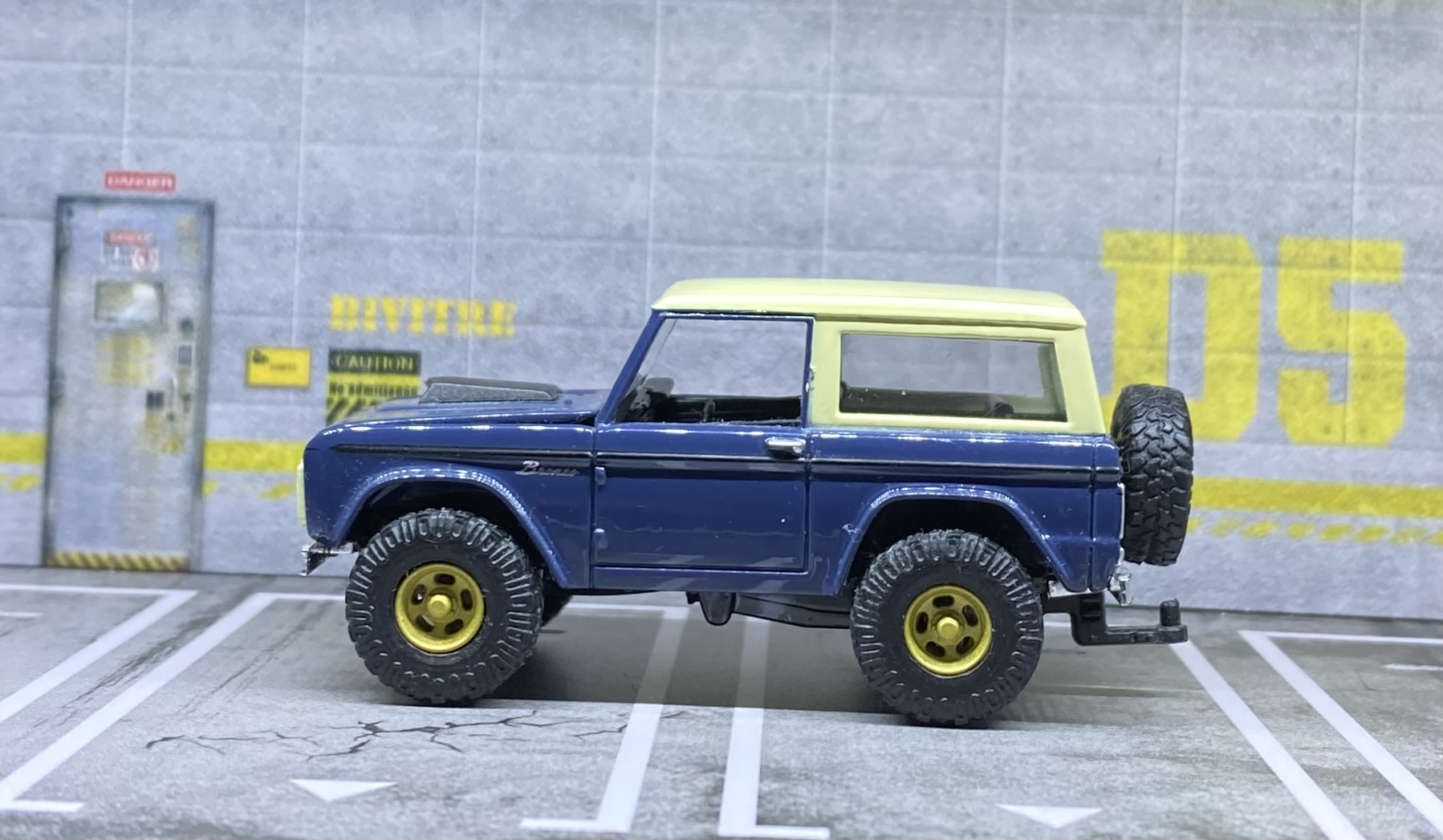
M2 Machines 1:64: 1966 Ford Bronco
The Ford Bronco is a model line of SUVs manufactured and marketed by Ford. The first SUV model developed by the company, five generations of the Bronco were sold from the 1966 to 1996 model years. A sixth generation of the model line was introduced for the 2021 model year. The nameplate has been used on other Ford SUVs, namely the 1984-1990 Bronco II compact SUV and the 2021 Bronco Sport compact crossover.
Originally developed as a compact off-road vehicle using its own chassis, the Bronco initially competed against the Jeep CJ-5 and International Scout. For 1978, Ford enlarged the Bronco, making it a short-wheelbase version of the F-Series pickup truck; the full-size Bronco now competed against the Chevrolet K5 Blazer and Dodge Ramcharger.
Following a decline in demand for large two-door SUVs, Ford discontinued the Bronco after the 1996 model year.
M2 Machines 1:64: 1966 Ford Bronco
The Ford Bronco is a model line of SUVs manufactured and marketed by Ford. The first SUV model developed by the company, five generations of the Bronco were sold from the 1966 to 1996 model years. A sixth generation of the model line was introduced for the 2021 model year. The nameplate has been used on other Ford SUVs, namely the 1984-1990 Bronco II compact SUV and the 2021 Bronco Sport compact crossover.
Greenlight 1:64: International Scout II
The International Scout is an off-road vehicle produced by International Harvester from 1960 to 1980. A precursor of more sophisticated SUVs to come, it was created as a competitor to the Jeep, and it initially featured a fold-down windshield. The Scout and second-generation Scout II were produced in Fort Wayne, Indiana as two-door trucks with removable hard tops, with options of a full-length roof, half-cab pickup, and/or soft top.
Scout IIs were manufactured from April 1971 to 1980. The design was finalized much earlier, with a version nearly identical to the production model shown to management in December 1967.
Scout II's could be ordered with the full metal Traveltop, the half-cab Roadster top (now seldom seen), or a soft top.
Before International discontinued the Scout in 1980, International experimented with Scout-based minivans, station wagons, dune buggies, Hurst-built special editions (in similar fashion to the Oldsmobile Hurst/Olds and Hurst SC/Rambler), and even a small motorhome. These plans were scrapped due to the International Harvester strike of 1979-80 and a lack of funds for the company to continue production of the Scout, let alone expand the Scout product line. The last IH Scout was produced on October 21, 1980.
M2 Machines 1:64: 1973 Chevrolet K5 Blazer 4x4
The Chevrolet K5 Blazer is a full-size sport-utility vehicle that was built by General Motors. Being GM's smallest full-size SUV, the K5 Blazer is part of the C/K truck series. Introduced to the Chevrolet line for the 1969 model year, the K5 Blazer was replaced for 1995 by the Chevrolet Tahoe. In 1970, GMC introduced its own model of the truck, called the Jimmy, which was discontinued in 1991 and replaced by the Yukon. The "Jimmy" name was chosen to reflect how GM may sound in a similar manner to how Jeep was thought to be a pronunciation of GP in the competing market. Both were short-wheelbase trucks and available with either rear- or four-wheel drive. Despite all Chevrolet versions from 1969 to 1988 having the "K5" badge, GM never internally referred to the model as the K5 Blazer/K5 Jimmy. Officially, the vehicles have always been referred to as the Blazer/Jimmy, without the K5 prefix. After the release of the S-Series Blazer/Jimmy in 1983, the models were officially renamed "Chevrolet Full-Size Blazer" and "GMC K-Jimmy" (V-Jimmy from 1987 to 1991), though they are often unofficially still addressed as "K5" to avoid confusion.
The K5 Blazer and Jimmy had "full convertible" removable tops until 1975. For 1976, GM introduced a half-cab design that was less prone to leaks and slightly safer in a roll-over. These half cabs had the convertible top begin a few inches behind the driver/passenger doors and run back to the tailgate.
BM Creations (BMC) 1:64: 1980 Toyota Hilux N60 N70
The Toyota Hilux, stylised as HiLux and historically as Hi-Lux, is a series of pickup trucks produced and marketed by the Japanese automobile manufacturer Toyota. The majority of these vehicles are sold as pickup truck or cab chassis variants, although they could be configured in a variety of body styles.
The pickup truck was sold with the Hilux name in most markets, but in North America, the Hilux name was retired in 1976 in favor of Truck, Pickup Truck, or Compact Truck. In North America, the popular option package, the SR5 (Sport Runabout 5-Speed), was colloquially used as a model name for the truck, even though the option package was also used on other Toyota models. In 1984, the Trekker, the wagon version of the Hilux, was renamed the 4Runner in Venezuela, Australia and North America, and the Hilux Surf in Japan. In 1992, Toyota introduced a newer pickup model, the full-size T100 in North America, necessitating distinct names for each vehicle other than Truck and Pickup Truck. Since 1995, the 4Runner is a standalone SUV, while in the same year Toyota introduced the Tacoma to replace the Hilux pickup in North America.
Greenlight 1:64: 1969 Volkswagen Type 3 Squareback
The Volkswagen Type 3 is a compact car manufactured and marketed by Volkswagen from 1961 to 1973. Introduced at the 1961 Frankfurt International Motor Show, the IAA, the Type 3 was marketed as the Volkswagen 1500 and later as the Volkswagen 1600, in two-door notchback, fastback, and station wagon body styles, the latter marketed as the 'Squareback' in the United States.
The Type 3 diversified Volkswagen's product range beyond the existing models—the Type 1 Beetles, Type 14 Karmann Ghia, Type 2 vans and pickups—while retaining Volkswagen's hallmark engineering features: the air-cooled rear-engine, rear-wheel drive train, body-on-chassis construction (with a backbone chassis integrated into the car's floorpan), as well as torsion bar front and rear suspension.
Despite using the Beetle's 2.40 m (94 in) wheelbase, the Type 3 was conceived as a larger car, offering a larger engine and increased cargo and passenger volume - the latter from its increased length and width as well as from its slab-sided, Ponton styling, maximizing the platform's footprint.
Johnny Lightning 1:64: 1966 Chevrolet El Camino
The Chevrolet El Camino is a coupé utility vehicle that was produced by Chevrolet between 1959–1960 and 1964–1987.
Unlike a standard pickup truck, the El Camino was adapted from the
standard two-door Chevrolet station wagon platform and integrated the
cab and cargo bed into the body.
Introduced in the 1959 model
year in response to the success of the Ford Ranchero coupé utility, its
first run, based on the Biscayne's B-body, lasted only two years.
Production resumed for the 1964–1977 model years based on the Chevelle
platform, and continued for the 1978–1987 model years based on the GM
G-body platform.
Although based on corresponding General Motors
car lines, the vehicle is classified in the United States as a
pickup.[1] GMC's badge engineered El Camino variant, the Sprint, was
introduced for the 1971 model year. Renamed Caballero in 1978, it was
also produced through the 1987 model year.
Greenlight 1:64: 1970 Chevrolet Chevelle SS 454
The Chevrolet Chevelle is a mid-sized automobile that was produced by Chevrolet in three generations for the 1964 through 1977 model years. Part of the General Motors (GM) A-body platform, the Chevelle was one of Chevrolet's most successful nameplates. Body styles included coupes, sedans, convertibles, and station wagons. The "Super Sport" versions were produced through the 1973 model year and Lagunas from 1973 through to 1976.
M2 Machines 1:64: 1973 Chevrolet Cheyenne Super 10 Custom SS
The Chevrolet C/K is a series of trucks that was manufactured by General Motors from the 1960 to 2002 model years. Marketed by both the Chevrolet and GMC divisions, the C/K series encompassed a wide range of vehicles. While most commonly associated with pickup trucks, the model line also included chassis-cab trucks and medium-duty trucks and served as the basis for GM full-size SUVs. Through its entire production, the model line competed directly against the Ford F-Series and the Dodge D series (later the Dodge Ram pickup).
Used for both the model branding and the internal model code, "C" denoted two-wheel drive, while "K" denoted four-wheel drive. Four generations of the C/K series were produced, including the GM monikered second-generation "Action Line" and third-generation "Rounded Line" vehicles (colloquially aka Square-Body trucks). For the fourth-generation (colloquially also known as OBS trucks), Chevrolet kept using the C/K designation while GMC revised its branding, changing to a singular GMC Sierra nameplate (C/K remained as an internal model code).
M2 Machines 1:64: 1971 Chevrolet G 10
The Chevrolet Van or Chevy Van (also known as the Chevrolet/GMC G-series vans and GMC Vandura) is a range of vans that was manufactured by General Motors from the 1964 to 1996 model years. Introduced as the successor for the rear-engine Corvair Corvan/Greenbrier, the model line also replaced the panel van configuration of the Chevrolet Suburban. The vehicle was sold both in passenger van and cargo van configurations as well as a cutaway van chassis that served as the basis for a variety of custom applications.
Produced across three generations (1964-1966, 1967-1970, and 1970-1996), the model line was sold under a wide variety of model names under both the Chevrolet and GMC brands. The first two generations were forward control vehicles (with the engine placed between the seats); the third generation adopted a configuration placing the engine forward of the driver. The second and third generations shared powertrain commonality with the C/K pickup truck model line.
After the 1996 model year, GM retired the G-Series vans, replacing them with the GMT600-platform Chevrolet Express and GMC Savana.
M2 Machines 1:64: 1976 GMC Sierra Grande 15 4X4
The Chevrolet C/K is a series of trucks that was manufactured by General Motors from the 1960 to 2002 model years. Marketed by both the Chevrolet and GMC divisions, the C/K series encompassed a wide range of vehicles.
NASCARShop 1:64: Rajah Caruth #71 Chevrolet Silverado
The Chevrolet Silverado is a range of trucks manufactured by General Motors under the Chevrolet brand. Introduced for the 1999 model year, the Silverado is the successor to the long-running Chevrolet C/K model line. Taking its name from the top trim level from the Chevrolet C/K series, the Silverado is offered as a series of full-size pickup trucks, chassis cab trucks, and medium-duty trucks. The fourth generation of the model line was introduced for the 2019 model year.
The Chevrolet Silverado shares mechanical commonality with the identically related GMC Sierra; GMC ended the use of the C/K nomenclature a model generation prior to Chevrolet. In Mexico, high-trim level versions of the Silverado use the Chevrolet Cheyenne name. The Silverado is among the best-selling vehicles in the United States, having sold over 12 million trucks since its introduction in 1998 as a 1999 model year.