Welcome to my blog. It was initially created in 2012 to post music I recorded. I posted a few quick experiments in 2013 and never posted music again, though I did record more. Since I already owned lots of boats and outboard motors, I decided to post about boats, ATVs and snowmobiles. I posted a few snowmobile photos and then nothing until 2025. Since I planned to sell my cottage and move south, I started selling all my boats and motors and switched to Radio Control vehicles in early 2024. In February 2025 I started collecting 1:64 scale diecast vehicles and decided to catalogue them on this blog...may you find freedom in my toys!

Wednesday, April 2, 2025

M2 Machines 1:64: 1967 Acadian Canso Sport

Acadian is a make of automobile produced by General Motors of Canada from 1962 to 1971. The Acadian was introduced so Canadian Pontiac-Buick dealers would have a compact model to sell, since the Pontiac Tempest was unavailable in Canada. Plans originally called for the Acadian to be based on the Chevrolet Corvair, which was produced at GM's Oshawa plant; however, the concept was moved to the Chevy II platform to be introduced for 1962. The brand was also offered in Chile, with models built in Africa.


M2 Machines 1:64: 1971 Dodge Charger Custom

The Dodge Charger is a model of automobile marketed by Dodge in various forms over eight generations since 1966.

The first Charger was a show car in 1964. A 1965 Charger II concept car resembled the 1966 production version.

In the United States, the Charger nameplate has been used on mid-size cars, personal luxury coupes, subcompact hatchbacks, and full-size sedans.


M2 Machines 1:64: 1970 Ford Mustang BOSS 429

The Boss 429 Mustang is a high-performance Ford Mustang variant that was offered by Ford in 1969 and 1970.


Majorette (Pink Slips) 1:64: Porsche 918 Spyder

The Porsche 918 Spyder is a high performance sports car manufactured by German marque Porsche. The 918 Spyder is a plug-in hybrid powered by a mid-mounted naturally aspirated 4.6 L (4,593 cc) V8 engine.


Hot Wheels 1:64: 2007 Aston Martin Vanquish

The Aston Martin Vanquish is a grand tourer introduced by British luxury automobile manufacturer Aston Martin in 2001 as a successor to the Aston Martin Virage (1993).

The Aston Martin V12 Vanquish, designed by Ian Callum and unveiled at the 2001 Geneva Motor Show, was produced from 2001 to 2007 as the flagship of the marque.


Auto World 1:64: 2023 Nissan Z

The Nissan Z, known in Japan as the Nissan Fairlady Z, is the seventh generation of the Z-car line of sports cars manufactured by Nissan. The model succeeded the 370Z, though is built on a modified and revised version of the previous generation's platform. The model also drops the numerical nomenclature of the previous generations.

The Z was introduced in August 2021. it featured Nissan's VR30DDTT engine and built on an evolution of Nissan FM Z34 platform, giving a model code "RZ34". It also has two transmission options, a 6-speed manual and a 9-speed automatic transmission. Deliveries began in late 2022 and was offered with two trims, "Performance" and "Sport". More powerful and track-focused, Z Nismo was introduced in July 2023 with significant upgrades over the standard version.


Hot Wheels 1:64: 1973 Honda Civic

The Honda Civic is a series of automobiles manufactured by Honda since 1972. As of 2023, the Civic is positioned between the Honda Fit/City and Honda Accord in Honda's global passenger car line-up.

The first-generation Civic was introduced in July 1972 as a two-door fastback sedan, followed by a three-door hatchback that September. With a 1,169 cc transverse engine and front-wheel drive, the car provided good interior space despite overall small dimensions. Initially gaining a reputation for being fuel-efficient, reliable and environmentally friendly, later iterations have become known for performance and sportiness, especially the Civic Si, SiR, and Type R versions.


Pop Race 1:64: 1972 Datsun 620

 In February 1972, the Datsun 620 truck was released and was in production until 1979. It was a regular cab truck (a longer "King Cab" version was released in 1977) and two wheelbases were offered, for a total of six different models. There was also a delivery van version, offered only in Japan. Naturally there were bare chassis models, and many importers installed locally made flat decks. There was also the U620, which is a crew cab "Utility" version. It uses a shorter, fully integrated bed to allow comfortably seating four people. The U620 was essentially a 620 pickup from the doors forward, with the bed and rear end being the only difference.


Hot Wheels 1:64: 1987 Ford Sierra Cosworth / Merkur XR4ti

The Ford Sierra is a mid-size/large family car manufactured and marketed by Ford of Europe from 1982-1993. It was designed by Uwe Bahnsen, Robert Lutz and Patrick Le Quément, and was noted for its aerodynamic styling. It has a drag coefficient of 0.34, a significant improvement over its predecessors.

The Sierra debuted at the 1982 British International Motor Show in Birmingham, then appeared at the 1982 Paris Salon de l'Automobile. Sales began on 15 October 1982, replacing the Ford Taunus TC3 and Ford Cortina Mark V. The Sierra's aerodynamic styling and the initial absence of a saloon alienated many conservative buyers, including company car drivers. A saloon was added in 1987 with the introduction of the facelifted Sierra.

Developed under the internal code name "Project Toni", the Sierra name is derived from the Spanish word for a mountain range. Most cars were manufactured in Belgium and the United Kingdom, although Sierras were also assembled in Cork, Ireland, Argentina, Venezuela, South Africa, and New Zealand.

The Merkur XR4Ti is a performance-oriented 3-door hatchback sold in North America from 1985 to 1989. A product of the Ford Motor Company, the car was a version of the European Ford Sierra adapted to U.S. regulations.


Tuesday, April 1, 2025

M2 Machines 1:64: 1959 Volkswagen Microbus Custom

The Volkswagen Transporter, initially the Type 2, is a range of light commercial vehicles, built as vans, pickups, and cab-and-chassis variants, introduced in 1950 by the German automaker Volkswagen as their second mass-production light motor vehicle series, and inspired by an idea and request from then-Netherlands-VW-importer Ben Pon.

Known officially (depending on body type) as the Transporter, Kombi or Microbus - or informally as the Volkswagen Station Wagon (US), Bus (also US), Camper (UK) or Bulli (Germany), it was initially given the factory designation 'Type 2', as it followed - and was for decades based on - the original 'Volkswagen' ("People's Car"), which became the VW factory's 'Type 1' after the post-war reboot, and mostly known, in many languages, as the "Beetle".

The Volkswagen Transporter has been built in many variants. It may be best known for its panel vans, but it was also built as a small bus or minivan, with choices of up to 23 windows and either hinged or sliding side doors. From the first generation, both regular and crew-cab, as well as long- and short-bed pickups, were made, and multiple firms sprang up to manufacture varying designs of camper vans, based on VW's Transporter models, to this day.

For the first 40 years, all VW Type 2 variants were forward control, with a VW-Beetle-derived flat-four engine in the rear, and all riding on the same (initial thirty years – T1 and T2), or similar (T3), 2.40 m (94 in) wheelbase as the Type 1 Beetle. As a result, all forward-control Type 2 pickups were either of standard-cab, long-bed or crew-cab, short-bed configuration, and because of the relatively high bed floor (above the rear, flat engine), most pickups came with drop sides in addition to the tailgate. In 1979, the third-generation Type 2 introduced an all-new, more square and boxy body, and in the 1980s also introduced a raised four-wheel-drive bus variant.


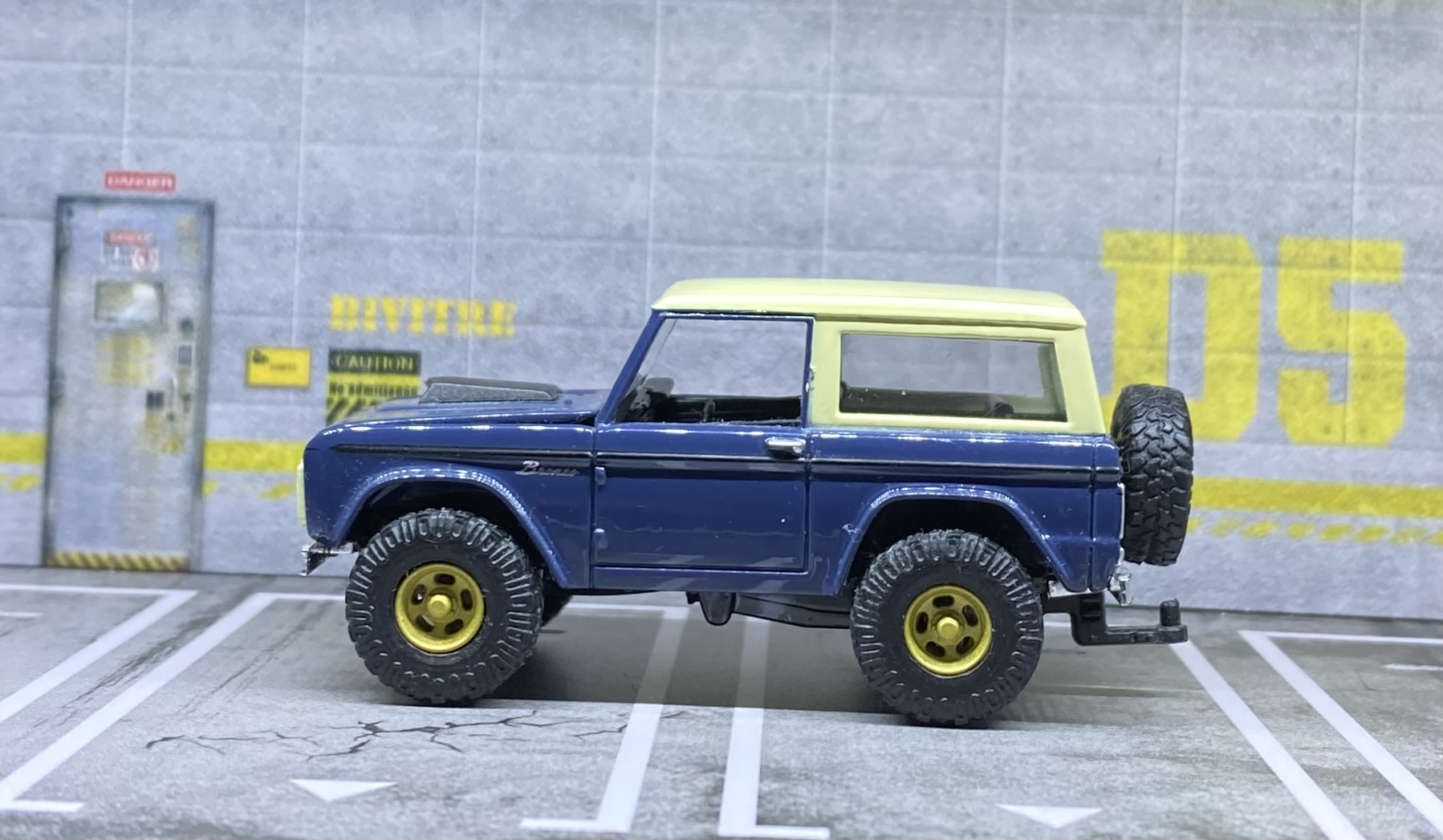
M2 Machines 1:64: 1966 Ford Bronco

The Ford Bronco is a model line of SUVs manufactured and marketed by Ford. The first SUV model developed by the company, five generations of the Bronco were sold from the 1966 to 1996 model years. A sixth generation of the model line was introduced for the 2021 model year. The nameplate has been used on other Ford SUVs, namely the 1984-1990 Bronco II compact SUV and the 2021 Bronco Sport compact crossover.

Originally developed as a compact off-road vehicle using its own chassis, the Bronco initially competed against the Jeep CJ-5 and International Scout. For 1978, Ford enlarged the Bronco, making it a short-wheelbase version of the F-Series pickup truck; the full-size Bronco now competed against the Chevrolet K5 Blazer and Dodge Ramcharger.

Following a decline in demand for large two-door SUVs, Ford discontinued the Bronco after the 1996 model year.


M2 Machines 1:64: 1966 Ford Bronco

The Ford Bronco is a model line of SUVs manufactured and marketed by Ford. The first SUV model developed by the company, five generations of the Bronco were sold from the 1966 to 1996 model years. A sixth generation of the model line was introduced for the 2021 model year. The nameplate has been used on other Ford SUVs, namely the 1984-1990 Bronco II compact SUV and the 2021 Bronco Sport compact crossover.


Greenlight 1:64: International Scout II

The International Scout is an off-road vehicle produced by International Harvester from 1960 to 1980. A precursor of more sophisticated SUVs to come, it was created as a competitor to the Jeep, and it initially featured a fold-down windshield. The Scout and second-generation Scout II were produced in Fort Wayne, Indiana as two-door trucks with removable hard tops, with options of a full-length roof, half-cab pickup, and/or soft top.

Scout IIs were manufactured from April 1971 to 1980. The design was finalized much earlier, with a version nearly identical to the production model shown to management in December 1967.

Scout II's could be ordered with the full metal Traveltop, the half-cab Roadster top (now seldom seen), or a soft top.

Before International discontinued the Scout in 1980, International experimented with Scout-based minivans, station wagons, dune buggies, Hurst-built special editions (in similar fashion to the Oldsmobile Hurst/Olds and Hurst SC/Rambler), and even a small motorhome. These plans were scrapped due to the International Harvester strike of 1979-80 and a lack of funds for the company to continue production of the Scout, let alone expand the Scout product line. The last IH Scout was produced on October 21, 1980.