The Alfa Romeo 33 Stradale is a mid-engine sports car built by Italian automobile manufacturer Alfa Romeo. It was the fastest commercially available car for the standing kilometer upon its introduction. 18 examples were produced between 1967 and 1969. "Stradale" (Italian for "road-going") is a term often used by Italian car manufacturers to indicate a street-legal version of a racing car; indeed the 33 Stradale was derived from the Tipo 33 sports prototype. Built in an attempt by Alfa Romeo to make some of its racing technology available to the public, it was also the most expensive automobile for sale to the public in 1968 at US$17,000 (equivalent to $153,700 in 2024).
Friday, April 25, 2025
Hot Wheels 1:64: 1989 Porsche 944 Turbo
The Porsche 944 is a sports car manufactured by German automobile manufacturer Porsche from 1982 until 1991. A front-engine, rear-wheel drive mid-level model based on the 924 platform, the 944 was available in coupé or cabriolet body styles, with either naturally aspirated or turbocharged engines. With over 163,000 cars produced, the 944 was the most successful sports car in Porsche's history until the introductions of the Boxster and 997 Carrera.
Extensive design revisions for the 1992 model year prompted Porsche to drop the 944 nameplate and rebrand the vehicle as the 968.
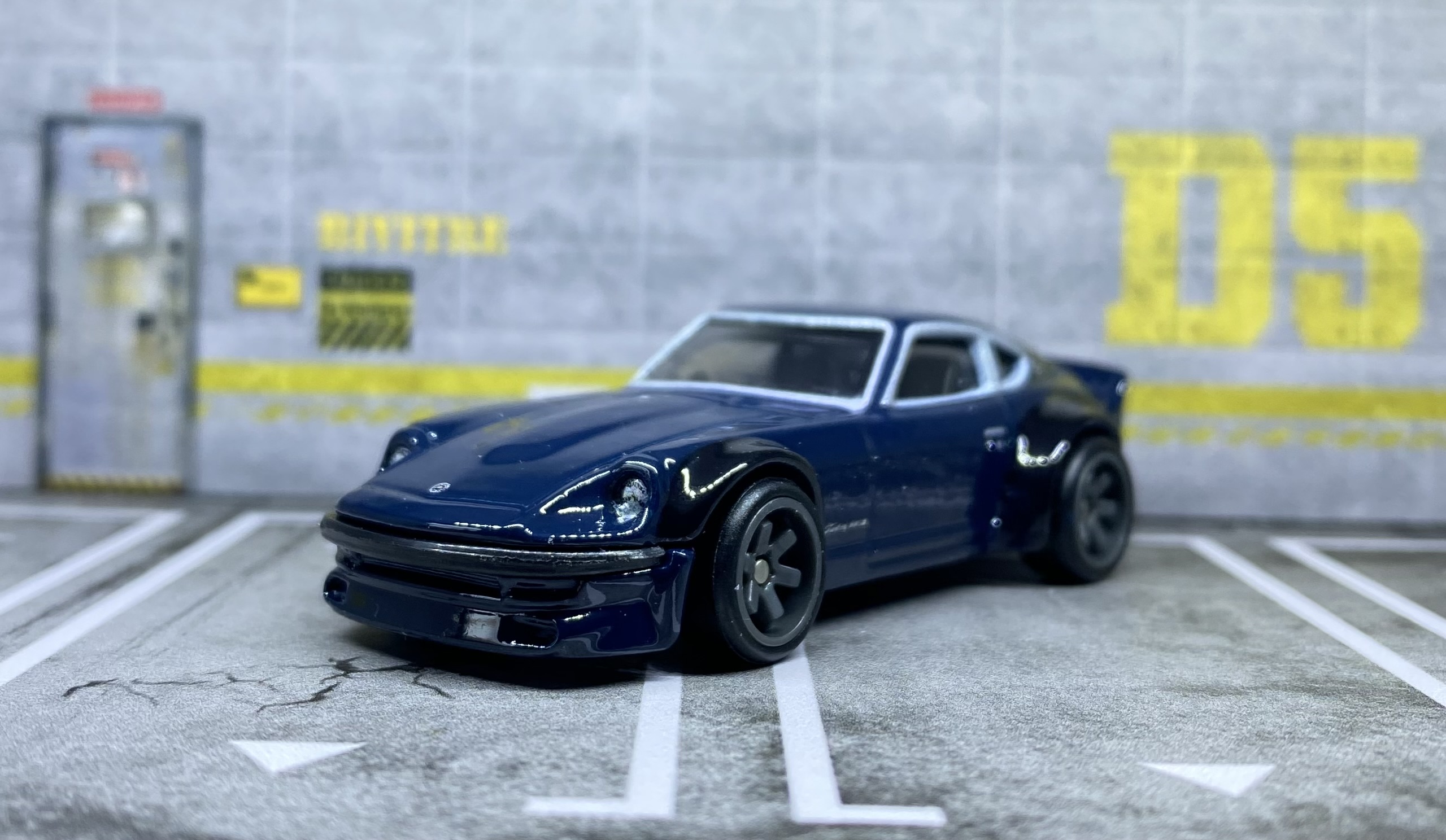
Hot Wheels 1:64: Nissan Fairlady Z
The Nissan S30, sold in Japan as the Nissan Fairlady Z but badged as the Datsun 240Z, 260Z, and 280Z for export, are 2-seat sports cars and 2+2 GT cars produced by Nissan from 1969 until 1978. The S30 was conceived of by Yutaka Katayama, the President of Nissan Motor Corporation U.S.A., and designed by a team led by Yoshihiko Matsuo, the head of Nissan's Sports Car Styling Studio. It is the first car in Nissan's Z series of sports cars.
The S30 had four-wheel independent suspension and a powerful straight-six engine with an overhead camshaft, features identified with far more expensive premium European sports cars and coupés such as the Jaguar E-Type and BMW 2800 CS, but absent from similarly priced sports cars such as the Alfa Romeo Spider, MGB and Opel GT, which had smaller four-cylinder engines and rear live axles. The S30's styling, engineering, relatively low price, and impressive performance resonated with the public, received a positive response from both buyers and the motoring press, and immediately generated long waiting lists.
As a halo car, the S30 broadened the acceptance of Japanese carmakers beyond their image as producers of practical and reliable but prosaic and unfashionable economy cars. Datsun's growing dealer network - compared to limited production imported sports cars manufactured by Jaguar, BMW, Porsche, Alfa Romeo, and Fiat - ensured both easy purchase and ready maintenance.
The S30 was initially sold alongside the smaller four-cylinder Datsun Sports, which was dropped from production in 1970. The S30 240Z is unrelated to the later 240SX, sold as the Silvia in Japan.
Hot Wheels 1:64: 1964 Chevrolet Chevy Nova Panel
The Chevrolet Chevy II / Nova is a small automobile manufactured by Chevrolet, and produced in five generations for the 1962 through 1979, and 1985 through 1988 model years. Built on the X-body platform, the Nova was the top selling model in the Chevy II lineup through 1968. The Chevy II nameplate was dropped after 1968, with Nova becoming the nameplate for all of the 1969 through 1979 models. It was replaced by the 1980 Chevrolet Citation introduced in the spring of 1979. The Nova nameplate returned in 1985, produced through 1988 as a S-car based, NUMMI manufactured, subcompact based on the front wheel drive, Japan home-based Toyota Sprinter.
Hot Wheels 1:64: Subaru Brat
The Subaru BRAT (acronym for "Bi-drive Recreational All-terrain Transporter") is a light-duty, four-wheel drive coupé utility, version of the Subaru Leone. It was sold from 1978 until 1994, introduced following the concept of coupe utilities such as the Chevrolet El Camino and the Ford Ranchero. The BRAT is also known as a Brumby, MV Pickup or Shifter depending on where it was sold.
Hot Wheels 1:64: 1972 Toyota Corolla Levin
The Corolla E20 was the second generation of cars sold by Toyota under the Corolla nameplate. Launched in May 1970, it featured "coke bottle styling" and had a longer 2,335 mm (91.9 in) wheelbase. The front suspension design was improved greatly, using a swaybar, however the rear remained relatively similar. The Corolla became the second-best selling car in the world that year. Grades for sedan were Standard, Deluxe, and Hi-Deluxe. The coupé was offered in Deluxe, SL, SR, and Levin ("levin" is Old English for "lightning") trim levels.
Hot Wheels 1:64: Alfa Romeo GTV6 3.0
The Alfa Romeo Alfetta (Type 116) is a front-engine, five-passenger saloon and fastback coupé manufactured and marketed by Italian automaker Alfa Romeo from 1972 to 1987 with a total of over 400,000 units produced during its production run.
The Alfetta was noted for the rear position of its transaxle (clutch and transmission) and its De Dion tube rear suspension - an arrangement designed to optimize handling by balancing front/rear weight distribution, as well as maintaining a low polar moment of inertia and low center of gravity. The interior of Coupé models featured a then unusual central tachometer placement - by itself, directly in front of the driver.
The Alfetta name, which means "little Alfa" in Italian is derived from the nickname of the Alfa Romeo Alfetta (Tipo 159), a successful Formula One car which in its last iteration introduced in 1951, paired a transaxle layout to De Dion tube rear suspension - like its modern namesake.
GTV 6 3.0
The GTV 6 3.0 was billed as the most powerful production sports car ever built by Alfa Romeo. The car was a co-operative effort by Alfa Romeo South Africa and Autodelta. It was developed mainly for racing, so only 200 had to be built for homologation. To compete with the BMW 535i, with a 3.5-litre engine, a new 3-litre variant of the V6 engine was installed. It won its debut race in the Lodge Group One International two-hour race at Kyalami 1983 and after that it took 1st and 2nd place in the Group One class of the Castrol three-hour race at Killarney and Index victory at the World Endurance Championship 1000 km Race at Kyalami in December 1983. The engine displacement is 2,934 cc, with bore and stroke both increased to 93 mm × 72 mm (3.66 in × 2.83 in). The fuel injection was replaced by six Dell'Orto carburettors (as used on the Alfa 6), as the aim was low-end torque rather than peak power. Power increased to 136.7 kW (185.9 PS; 183.3 hp) at 6,700 rpm. The gearing was lowered but the 3.0 still reached a higher top speed of 224.2 km/h (139.3 mph). Acceleration times are 8.36 seconds from 0–100 km/h and 7.2 seconds for 0–60 mph. On the outside, the different induction system of the GTV6 3.0 required a new fiberglass bonnet with a prominent bulge.
Hot Wheels 1:64: 1970 Rover P6
The Rover P6 series (named as the 2000, 2200, or 3500, depending on engine displacement) is a saloon car produced by Rover and subsequently British Leyland from 1963 to 1977 in Solihull, West Midlands, England, UK.
The P6 was the first winner of the European Car of the Year award.
Hot Wheels 1:64: Volkswagen Brasilia
The Volkswagen Brasília is a rear-engined small family car developed by Volkswagen do Brasil and internally designated as the Type 321. Named for Brazil's capital city, the car was manufactured and marketed by Volkswagen in Brazil from 1973 to 1982; in Mexico from 1975 to 1982; and built from knock down kits in Nigeria, where it was marketed as the Igala from 1976 to 1980.
Designed to replace the Beetle (called the Fusca in Brazil), and available in both three-door and five-door hatchback body styles, the Brasília combined VW's air-cooled engine with the chassis of the Volkswagen Karmann Ghia and styling reminiscent of the Volkswagen 412. By the end of 1982, over one million examples had been manufactured.
Greenlight 1:64: 1976 GMC Vandura
The Chevrolet Van or Chevy Van (also known as the Chevrolet/GMC G-series vans and GMC Vandura) is a range of vans that was manufactured by General Motors from the 1964 to 1996 model years. Introduced as the successor for the rear-engine Corvair Corvan/Greenbrier, the model line also replaced the panel van configuration of the Chevrolet Suburban. The vehicle was sold both in passenger van and cargo van configurations as well as a cutaway van chassis that served as the basis for a variety of custom applications.
Produced across three generations (1964-1966, 1967-1970, and 1970-1996), the model line was sold under a wide variety of model names under both the Chevrolet and GMC brands. The first two generations were forward control vehicles (with the engine placed between the seats); the third generation adopted a configuration placing the engine forward of the driver. The second and third generations shared powertrain commonality with the C/K pickup truck model line.
After the 1996 model year, GM retired the G-Series vans, replacing them with the GMT600-platform Chevrolet Express and GMC Savana.
Thursday, April 24, 2025
Johnny Lightning 1:64: 1980 Chevrolet Monte Carlo
The Chevrolet Monte Carlo is a two-door coupe that was manufactured and marketed by the Chevrolet division of General Motors. Deriving its name from the city in Monaco, the Monte Carlo was marketed as the first personal luxury car of the Chevrolet brand. Introduced for the 1970 model year, the model line was produced across six generations through the 2007 model year, with a hiatus from 1989 until 1994. The Monte Carlo was a variant of the Pontiac Grand Prix throughout its production.
From 1970 until 1972, the Monte Carlo rode on the unique "A-Special" platform with the Grand Prix, shifting to the standard A-body intermediate chassis from the 1973 through 1977 model years. For 1978, the Monte Carlo line underwent downsizing, but was still considered a midsized coupe. The rear-wheel drive A-body platform of this generation of Monte Carlo was redesignated as the G-body when GM's front-wheel drive A-body cars were introduced for the 1982 model year. After an abbreviated 1988 model year, the Monte Carlo was replaced by the two-door Chevrolet Lumina.
For the 1995 model year, the Monte Carlo was revived, replacing the two-door Lumina. It shared the front-wheel drive W-platform with the two-door Grand Prix, and was the largest coupe in the Chevrolet lineup. After the 2002 model year, the Grand Prix coupe was discontinued, the Monte Carlo became the largest two-door model produced by an American auto manufacturer.
In response to declining sales of the model line, Chevrolet discontinued the Monte Carlo after the 2008 model year. During much of its production, the Monte Carlo represented the Chevrolet brand in stock car racing. During the 1980s, the Monte Carlo SS was introduced, featuring aerodynamically-enhanced styling; as part of its revival, the Monte Carlo again represented Chevrolet in stock car racing from 1995 through its discontinuation.
Greenlight 1:64: 1968 Chevrolet Chevy II SS
The Chevrolet Chevy II / Nova is a small automobile manufactured by Chevrolet, and produced in five generations for the 1962 through 1979, and 1985 through 1988 model years. Built on the X-body platform, the Nova was the top selling model in the Chevy II lineup through 1968. The Chevy II nameplate was dropped after 1968, with Nova becoming the nameplate for all of the 1969 through 1979 models. It was replaced by the 1980 Chevrolet Citation introduced in the spring of 1979. The Nova nameplate returned in 1985, produced through 1988 as a S-car based, NUMMI manufactured, subcompact based on the front wheel drive, Japan home-based Toyota Sprinter.
Third Generation (1968-1974):
The 1968 models were fully-redesigned with an extensive restyle on a longer 111-inch wheelbase that gave Chevrolet's compacts a chassis that was just one inch shorter than that of the midsize Chevelle coupe. The station wagon and hardtop sport coupe were discontinued, the former in line with an industry trend which left AMC the only American maker of compact station wagons until Chrysler rejoined the market in 1976 (the 1966–70 Ford Falcon wagon was actually midsize, using a bodyshell identical to the Fairlane wagon's). One notable change was the front subframe assembly — as compared with Ford, Chrysler and AMC, in whose cars the entire front suspension was integrated with the bodyshell, a separate subframe housing the powertrain and front suspension (similar to the front part of the frame of GM's full-size, full-framed vehicles) replaced the earlier style. Although the front subframe design was unique for the Nova, the Camaro introduced a year earlier was the first to incorporate such a design; the redesigned Nova was pushed a year ahead to 1968 instead of 1969. The sales brochure claimed 15 powertrain choices for coupes and a dozen for sedans. Options included power brakes and steering, Four-Season or Comfort-Car air conditioning, rear shoulder belts, and head restraints. There were a few Chevrolet Novas built with the 194 ci (3.1 L), the same engine that had been used in the previous generations of the Chevy II. Sales of the 1968 Chevy II Nova fell by half.
In 1969 Chevrolet dropped the Chevy II portion of its compact car's name; it was now known simply as the Chevrolet Nova. The 153 cu in (2.51 L) four-cylinder engine was offered between 1968 and 1970, then was dropped due to lack of interest (besides its other usage in the Jeep DJ-5A a.k.a. the Postal Jeep or a marine/industrial engine) and to clear the field for the Vega. Far more popular were the 230 cu in (3.8 L) six-cylinder and the base 307 cu in (5.03 L) V8, which replaced the 283 cu in (4.64 L) V8 offered in previous years. Several units were produced with the 327 cu in (5.36 L), 275 hp (205 kW), engine, four-barrel quadrajet carb and four-speed Saginaw transmission with a heavy-duty 12-bolt positraction rear as a "towing option' package. At mid-year, a semi-automatic transmission based on the Powerglide called the Torque-Drive (RPO MB1) was introduced as a low-cost option (~$100 less than the Powerglide) for clutchless motoring. The Torque-Drive transmission was only offered with the four and six-cylinder engines. The two-speed Powerglide was still the only fully-automatic transmission available with most engines, as the more desirable three-speed Turbo-Hydramatic was only available with the largest V8 engines.
Johnny Lightning 1:64: 1970 Dodge Coronet Super Bee
The Dodge Super Bee is a mid-sized muscle car marketed by Dodge, that was produced for the 1968 through 1971 model years.
In Mexico, the Super Bee was based on a compact-sized Chrysler platform and marketed from 1970 until 1980.
The Super Bee model name was resurrected for the 2007, 2008, 2009, 2012, and 2013 Dodge Charger Super Bee models.