The Datsun truck is a compact pickup truck made by Nissan in Japan from 1955 through 1997. It was originally sold under the Datsun brand, but this was switched to Nissan in 1983. It was replaced in 1997 by the Frontier and Navara.


The Datsun truck is a compact pickup truck made by Nissan in Japan from 1955 through 1997. It was originally sold under the Datsun brand, but this was switched to Nissan in 1983. It was replaced in 1997 by the Frontier and Navara.
The Land Rover Defender (introduced as the Land Rover One Ten, joined in 1984 by the Land Rover Ninety, plus the extra-length Land Rover One Two Seven in 1985) is a series of British off-road cars and pickup trucks. They have four-wheel drive, and were developed in the 1980s from the Land Rover series which was launched at the Amsterdam Motor Show in April 1948. Following the 1989 introduction of the Land Rover Discovery, the term 'Land Rover' became the name of a broader marque, no longer the name of a specific model; thus in 1990 Land Rover renamed them as Defender 90 and Defender 110 and Defender 130 respectively.
The vehicle, a British equivalent of the Second World War derived (Willys) Jeep, gained a worldwide reputation for ruggedness and versatility. With a steel ladder chassis and an aluminium alloy bodywork, the Land Rover originally used detuned versions of Rover engines.
Though the Defender was not a new generation design, it incorporated significant changes compared to the Land Rover series, such as adopting coil springs front and rear. Coil springs offered both better ride quality and improved axle articulation. The addition of a centre differential to the transfer case gave the Defender permanent four-wheel-drive capability. Both changes were derived from the original Range Rover, and the interiors were also modernised. Whilst the engines were carried over from the Series III, a new series of modern and more powerful engines was progressively introduced.
Even when ignoring the series Land Rovers and perhaps ongoing licence products, the 90/110 and Defender models' 33-year production run were ranked as the sixteenth longest single-generation car in history in 2020.
In 2020, Jaguar Land Rover introduced an all new generation of Land Rover Defender Land Rover Defender (L663) switching from body on chassis to integrated bodywork and from live, rigid axles to all around independent suspension.


The Datsun 510 was a series of the Datsun Bluebird sold from 1968 to 1973. Outside the US it was sold as either the Datsun Bluebird or as the Datsun 1300/1400/1500/1600/1800 (depending on engine variant).
The rear-wheel drive 510's engineering was inspired by contemporary European sedans, particularly the 1966 BMW 1600-2 – incorporating an overhead camshaft engine and four-wheel independent suspension by means of MacPherson struts in front, and semi-trailing arms on the rear wheels. The styling is attributed to Datsun in-house designer, Teruo Uchino.
Nissan USA president Yutaka Katayama pushed for offering this generation of the Bluebird with a larger overhead cam engine with more power than the preceding models. The design originated with Prince Motor Company, which merged with Nissan in 1966. The Bluebird series had been Datsun's smaller offering, but the 1966 introduction of the 1-litre Sunny allowed Nissan to move the Bluebird up into the mid-size category.
The 510-series Bluebird was released in the domestic Japanese market on August 15, 1967. In the United States, the Datsun 510 was launched in October 1967 as a four-door sedan, followed by a two-door sedan (June 1968), five-door station wagon, and two-door coupé (November 1968). In Canada it was sold as the Datsun 1600.
The range became famous for Nissan's rallying successes outside Japan and paved the way for greater Nissan sales internationally.
The series was available with either a four-speed manual transmission or optional three-speed automatic. 510s, in some markets, offered twin Hitachi side-draft carburetors, which were a smaller version of the British SU design used on Jaguars and MGs. These engines also used enhanced compression and camshaft profiles to produce more power. SSS models (not offered in North America) offered upgraded instrumentation and interior trim, as well as appropriate exterior badges.


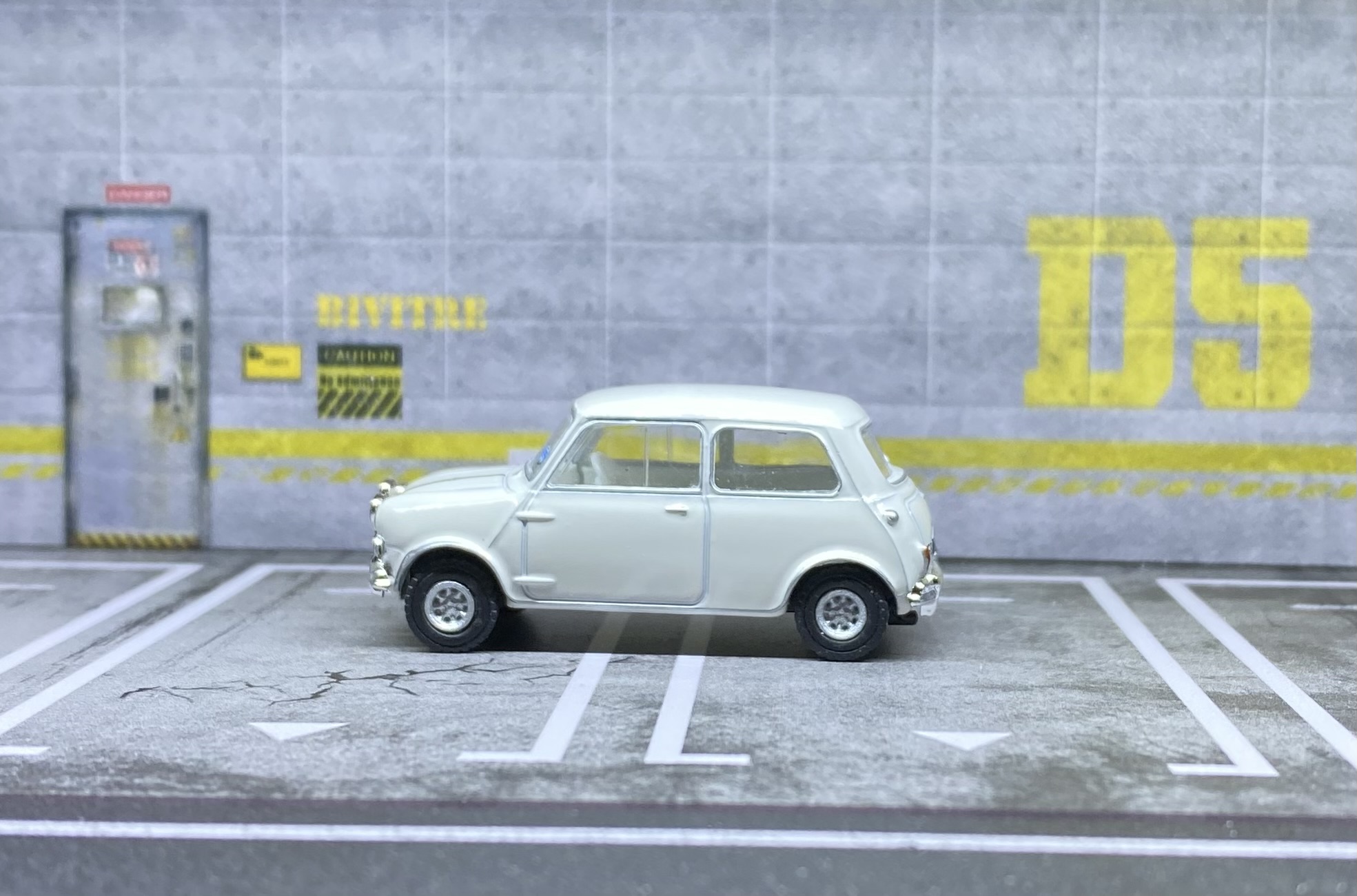
The Mark I Mini (1959–1967) was the first version of British Motor Corporation's Mini model. It is characterised by its sliding windows, external door hinges and "moustache" grille. In the United Kingdom the Mark I was produced between 1959 and 1967 at the Longbridge Plant near BMC's headquarters, with production in Australia continuing until 1970. The Mini Mark I was sold under both Austin and Morris marque names.



The Volkswagen Golf Mk1 is the first generation of a small family car manufactured and marketed by Volkswagen. It was noteworthy for signalling Volkswagen's shift of its major car lines from rear-wheel drive and rear-mounted air-cooled engines to front-wheel drive with front-mounted, water-cooled engines that were often transversely-mounted.
Successor to Volkswagen's family van the first generation Golf debuted in Europe in May 1974 with styling by Giorgetto Giugiaro's Italdesign.


The Mazda Grand Familia is an automobile which was produced by Mazda in Japan from 1971 to 1978. It was sold as the Mazda 808 in some export markets including Asia, Australia, and New Zealand, and as the Mazda 818 in many others - this was mostly due to Peugeot having trademarked three-digit numbers with a middle zero in many markets. The body style configurations offered were a two-door coupé, a four-door sedan, and a five-door station wagon. The Grand Familia offered only inline four cylinder engines. The largely identical rotary-powered versions were marketed as the Mazda Savanna in Japan, with export markets taking this model as the Mazda RX-3.
The Grand Familia/Savanna were originally intended to replace the smaller Mazda Familia to better compete with the Toyota Corolla, Nissan Sunny, and Mitsubishi Colt. With the onset of the 1970s energy crisis however, the Familia sold better due to its fuel economy. Since Mazda had already developed the Grand Familia/Savanna, it was sold globally as a somewhat larger, more upscale alternative to the Familia/1000/1300 and in North America it was Mazda's smallest offering.


The Datsun 510 was a series of the Datsun Bluebird sold from 1968 to 1973. Outside the US it was sold as either the Datsun Bluebird or as the Datsun 1300/1400/1500/1600/1800 (depending on engine variant).
The
rear-wheel drive 510's engineering was inspired by contemporary
European sedans, particularly the 1966 BMW 1600-2 – incorporating an
overhead camshaft engine and four-wheel independent suspension by means
of MacPherson struts in front, and semi-trailing arms on the rear
wheels. The styling is attributed to Datsun in-house designer, Teruo
Uchino.
Nissan USA president Yutaka Katayama pushed for offering
this generation of the Bluebird with a larger overhead cam engine with
more power than the preceding models. The design originated with Prince
Motor Company, which merged with Nissan in 1966. The Bluebird series had
been Datsun's smaller offering, but the 1966 introduction of the
1-litre Sunny allowed Nissan to move the Bluebird up into the mid-size
category.
The 510-series Bluebird was released in the domestic
Japanese market on August 15, 1967. In the United States, the Datsun 510
was launched in October 1967 as a four-door sedan, followed by a
two-door sedan (June 1968), five-door station wagon, and two-door coupé
(November 1968). In Canada it was sold as the Datsun 1600.
The
range became famous for Nissan's rallying successes outside Japan and
paved the way for greater Nissan sales internationally.
The
series was available with either a four-speed manual transmission or
optional three-speed automatic. 510s, in some markets, offered twin
Hitachi side-draft carburetors, which were a smaller version of the
British SU design used on Jaguars and MGs. These engines also used
enhanced compression and camshaft profiles to produce more power. SSS
models (not offered in North America) offered upgraded instrumentation
and interior trim, as well as appropriate exterior badges.


The Datsun Sunny truck debuted in February 1967 and was the light commercial truck variation of the B10 passenger models. It was based on the VB10 van chassis, and is a body style which is sometimes referred to as a "coupé utility", as the bed is not separate from the passenger area. The introduction of a pickup truck based on the Sunny gave Nissan Saito Store and Nissan Cherry Store Japanese dealerships the opportunity to sell a commercial vehicle that was originally only offered at Nissan Store. The 520 series Datsun Truck shared its platform with the Datsun Bluebird, plus the larger Nissan Junior sharing an engine with the Nissan Cedric; Nissan decided to duplicate the success it had with a Bluebird-based pickup truck for the new Sunny platform. The Sunny was engineered by newly acquired Aichi Machine Industry Co., Ltd., and gave the new acquisition the ability to demonstrate their profitability to their new Nissan owners. The Sunny truck dimensions were in compliance with Japanese Government dimension regulations and the small displacement engines reduced the annual road tax obligation. The B20 used the same wheelbase and running gear as does the Datsun Sunny VB10 van, and shared its dimensions.


The Mazda Cosmo was an automobile produced by Mazda from 1967 to 1996. During its production run, the Cosmo served as a "halo" vehicle for Mazda, with the first Cosmo successfully launching the Mazda Wankel engine. The final generation of the Cosmo served as Mazda's flagship vehicle in Japan, sold as the Eunos Cosmo through its luxury Eunos division in Japan.
Mazda decided on the name "cosmo", reflecting international cultural fascination with the Space Race, Mazda wanted to showcase the Mazda Wankel engine as forward-thinking, with focus on future developments and technology.


The Nissan Skyline is a brand of automobile originally produced by the Prince Motor Company starting in 1957, and then by Nissan after the two companies merged in 1967. After the merger, the Skyline and its larger counterpart, the Nissan Gloria, were sold in Japan at dealership sales channels called Nissan Prince Shop.
The Skyline was largely designed and engineered by Shinichiro Sakurai from inception, and he remained a chief influence of the car until his death in 2011.
Skylines are available in either coupé, or sedan body styles, plus station wagon, crossover, convertible and pickup/sedan delivery body styles. The later models are most commonly known by their trademark round brake and tail lights. The majority of Skyline models are rear-wheel drive, with all-wheel drive being available since the debut of the eighth-generation Skyline (R32).
“Skyline GT (S54A-1)” is a special machine that Prince Motors, Ltd. produced to win the 2nd Japan Grand Prix “GT-II Race” on May 3rd, 1964. It was manufactured by extending the wheelbase of Skyline 1500 (S50) by 200mm to mount the 6-cylinder “G7” engine originally for Gloria and was rolled out on May 1st to get entry qualifications. Actual race cars were equipped with “sports options” including Weber triple carburetors, the 5-speed close-ratio transmission, the non-slip differential, etc.


The Volvo 140 Series is a line of mid-size cars manufactured and marketed by Volvo from 1966 to 1974 in two- and four-door sedan (models 142 and 144 respectively) as well as five-door station wagon (model 145) body styles, with numerous intermediate facelifts. More than a million Volvo 140s were built in 8 years.


I got rid of all my 1:64 diecast cars (mainly Hot Wheels) back in 1983 or 1984. However, this was gifted to me later in the 80s and was the only "Dinky Car" I had until I started collecting in February 2025.


The MGB is a two-door sports car manufactured and marketed from 1962 until 1980 by the British Motor Corporation (BMC), later the Austin-Morris division of British Leyland, as a four-cylinder, soft-top sports car. It was announced and its details first published on 19 September 1962. Variants include the MGB GT three-door 2+2 coupé (1965-1980), the six-cylinder sports car and coupé MGC (1967-1969), and the eight-cylinder 2+2 coupé, the MGB GT V8 (1973-1976).
Replacing the MGA in 1962, production of the MGB and its variants continued until 1980, though fixed roof GT models ceased export to the US in 1974. Sales for the MGB, MGC and MGB GT V8 combined totaled 523,836 cars. After a 12-year hiatus, the MGB re-entered production as the heavily modified MG RV8 with a limited run of 2,000 cars before its final replacement in 1995 by the MG F.


